1. Introduction and Scope
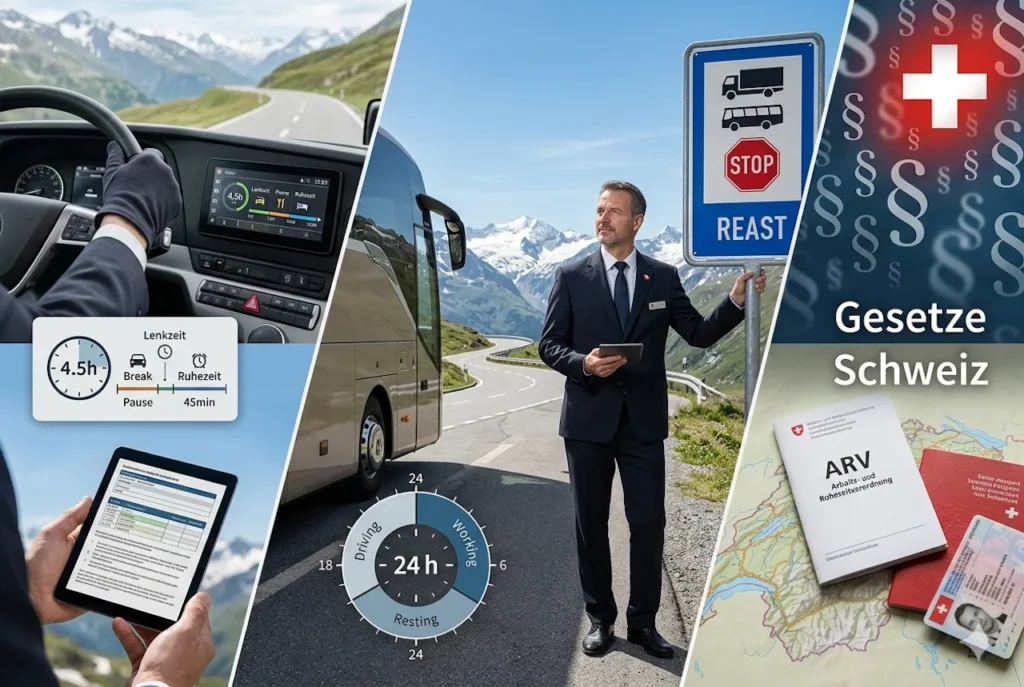
The working, driving, and rest periods of bus drivers in Switzerland are governed by a multi-tiered system of legal provisions. Depending on the type of operation (private bus company, licensed public transport, national or international operations), different laws and ordinances apply.
Swiss law fundamentally distinguishes between the following sets of regulations:
- ARV 1 (Chauffeur Ordinance, SR 822.221): Applies to professional drivers of buses with more than 8 passenger seats (plus the driver’s seat) that are not subject to the AZG.
- ARV 2 (SR 822.222): Applies to professional drivers of light passenger transport vehicles and heavy passenger cars not covered by ARV 1 or the AZG.
- AZG / AZGV (SR 822.21 / SR 822.211): Working Hours Act for employees in the operating service of public transport companies (licensed bus, rail, tram, and shipping operators).
- EU Regulation (EC) No. 561/2006: Applies to vehicles from EU Member States operating in Switzerland, as well as to cross-border transport (CH-EU Land Transport Agreement).
- AETR Agreement (SR 0.822.725.21): Applies to international trips to and through Switzerland involving non-EU countries.
| Driver Type / Company | National Regulations | International Regulations |
|---|---|---|
| Private bus company (long-distance bus, tour bus) | ARV 1 | AETR / Regulation 561/2006 |
| Licensed public transport (SBB Bus, city bus, etc.) | AZG / AZGV | AETR (for international trips) |
| Small van / minibus up to 8+1 seats | ARV 2 | ARV 2 / AETR |
| EU vehicles in Switzerland | Regulation (EC) 561/2006 | Regulation (EC) 561/2006 |
2. ARV 1 – Chauffeur Ordinance
(Ordinance on the Working and Rest Periods of Professional Motor Vehicle Drivers – SR 822.221)
2.1 Scope of ARV 1
ARV 1 (Chauffeur Ordinance) applies to drivers of:
- Vehicles and vehicle combinations with a permissible gross weight exceeding 3.5 tonnes (freight transport)
- Passenger vehicles (buses) with more than 8 seats plus the driver’s seat (i.e., vehicles with 10 or more seats)
- These vehicles must be licensed for passenger transport or used commercially
ARV 1 is the Swiss equivalent of EU Regulation 561/2006 and is closely aligned with the AETR Agreement. It was last substantially amended on May 1, 2025.
2.2 Driving Times
ARV 1 specifies the following maximum driving times (Art. 6 ARV 1 / Art. 6 AETR):
| Parameter | Regulation |
|---|---|
| Daily driving time (normal day) | Maximum 9 hours |
| Daily driving time (extended) | Up to 10 hours (no more than twice per week) |
| Weekly driving time | Maximum 56 hours |
| Driving time over 2 consecutive weeks | Maximum 90 hours |
Legal basis: Art. 6 ARV 1 (SR 822.221); Art. 6 AETR Agreement; Art. 6 Regulation (EC) 561/2006
2.3 Breaks (Driving Time Interruptions)
According to Art. 7 ARV 1, the following breaks must be taken after a driving period of 4 hours and 30 minutes:
- Minimum break: 45 minutes in one piece, OR
- Split break: First, an initial break of at least 15 minutes, followed by a second break of at least 30 minutes
- The breaks must be taken in the specified order (15 minutes before the 30 minutes)
- No other work may be performed during the breaks
Special provision effective May 1, 2025 (round trips): For round trips in passenger transport, the 45 minutes may be divided into two breaks of at least 15 minutes each (totaling at least 45 minutes), provided that the daily driving time does not exceed 7 hours.
2.4 Daily Rest Period
According to Art. 8 ARV 1, bus drivers must observe the following minimum rest periods:
- Regular daily rest period: At least 11 consecutive hours
- Reduced daily rest period: 9 consecutive hours (maximum 3 times between two weekly rest periods)
- A reduced rest period does not need to be compensated
- Split daily rest period: The rest period may be divided into two parts: first part at least 3 hours, second part at least 9 hours
- With a split rest period, the total rest period must be at least 12 hours
- For multi-day trips (with co-driver): 9 hours within a 30-hour period
2.5 Weekly Rest Period
The weekly rest period under Art. 8 ARV 1 is:
- Regular weekly rest period: At least 45 consecutive hours
- Reduced weekly rest period: At least 24 consecutive hours
- The difference from the regular rest period must be made up within 3 weeks
- The make-up time must be attached en bloc to another rest period
New regulation effective May 1, 2025 (domestic round trips): The weekly rest period may be taken only after 12 working days (instead of after 6 days), provided that the daily driving time does not exceed 7 hours.
2.6 Exceptions and Special Regulations
International special rule for passenger transport (12-day rule)
For international trips (occasional services) where the driver is outside the country, the weekly rest period may be postponed for 12 consecutive working days, provided the following conditions are met:
- Before the trip: A regular weekly rest period of 45 hours
- After the trip: Two consecutive regular weekly rest periods
- Daily driving time: Must not exceed 10 hours on any given day
Scheduled services up to 50 km
Simplified regulations apply to regular scheduled bus service with a route length of up to 50 km (Art. 2(1) ARV 1):
- These drivers generally fall under ARV 2 (not ARV 1)
- Exception: If the company employs both ARV 1 and ARV 2 drivers, it may apply uniform rules
3. ARV 2 – Light Passenger Transport Vehicles and Local Transport
(Ordinance on the Working and Rest Periods of Professional Drivers of Light Passenger Transport Vehicles and Heavy Passenger Cars – SR 822.222)
3.1 Scope
ARV 2 applies to professional drivers of:
- Vehicles with a maximum of 8 passenger seats (plus the driver’s seat), i.e., vehicles with up to 9 seats
- Local scheduled buses with a route length of up to 50 km that are not subject to the AZG and do not fall under ARV 1
- Taxi services and private shuttle services (commercial)
Important: ARV 2 does not apply to employees in the operating service of licensed public transport companies (these are subject to the AZG).
3.2 Driving Times and Working Hours
- Daily driving time: Maximum 9 hours (up to 10 hours no more than twice per week)
- Maximum working time: 10 hours per day
- Weekly working hours: Average maximum of 48 hours over 6 months
3.3 Breaks
- After 4.5 hours of driving: At least 45 minutes break
- For drivers in scheduled service up to 50 km: Break of at least 30 minutes after 4.5 hours of driving
- Split break possible: 15 minutes + 30 minutes (in this order)
3.4 Rest Periods
- Daily rest period: At least 10 consecutive hours (or reduced to 9 hours, max. 3 times per week)
- Weekly rest period: At least 36 hours, of which 24 hours must be consecutive
Legal basis: SR 822.222, Art. 4–12; fedlex.admin.ch
4. AZG / AZGV – Working Hours Act for Public Transport
(Federal Act on Work in Public Transport Companies – SR 822.21 / Ordinance to the AZG – SR 822.211)
4.1 Scope of the AZG
The AZG is a special law that applies exclusively to employees in the operating service of licensed public transport companies. These include:
- Bus operators licensed by the Federal Office of Transport (BAV): PostAuto, private buses with public transport licenses, city buses such as Bernmobil, TPG, ZVB, AAGR, etc.
- Railway companies (SBB, BLS, RhB, SOB, etc.)
- Tram companies
- Cable cars and ski lifts
- Inland navigation companies
The AZG does NOT apply to private bus companies without a public transport license (ARV 1 applies to these) and does NOT apply to administrative staff (the ArG, Labour Act, applies to them).
4.2 Duty Hours (Working Hours)
The AZG distinguishes between duty shift, driving time, and standby time:
| Concept | Regulation |
|---|---|
| Duty shift (time window from start to end of shift) | Average max. 12 hours; once per workweek up to 13 hours |
| Uninterrupted working time | Must not exceed 5 hours (once: up to 5:10 hours) |
| Average weekly working time | 50 hours per week (average), maximum 55 hours in a single week |
| Maximum annual working time | Determined in the collective labour agreement (GAV) |
| Night and Sunday work | Permitted within the scope of operations, with corresponding premiums per the GAV |
4.3 Breaks (per AZGV)
The AZGV (SR 822.211) regulates breaks for operating personnel in public transport:
- Regular break: At least 1 hour for a duty shift exceeding 6 hours
- Reduced break to 45 minutes: Possible after consultation with employees or their representatives
- Reduced break to 30 minutes: Possible by agreement with employees or their representatives
- Short break: During an uninterrupted working period of up to 5 hours, no break of less than 10 minutes may be counted as a valid break
4.4 Rest Periods and Rest Days
The AZG distinguishes between rest periods (between duties) and rest days (days off):
- Rest period before a rest day: Average at least 12 hours, in individual cases at least 9 hours
- Rest day: Average at least 36 hours, in individual cases at least 33 hours
- Compensatory days: Approx. 52 per year; at least 24 hours (may be reduced to 22 hours by agreement)
- Annual leave: Per the GAV (collective labour agreement), at least 4 weeks for adults
Legal basis: SR 822.21 (AZG), SR 822.211 (AZGV); Supervisory authority: Federal Office of Transport (BAV)
5. EU Regulation 561/2006 and AETR Agreement
5.1 EU Regulation (EC) No. 561/2006
EU Regulation (EC) No. 561/2006 of the European Parliament and of the Council of March 15, 2006, governs driving and rest periods in commercial road transport in the EU. For Switzerland, this regulation applies via the Land Transport Agreement between the EU and Switzerland (in force since 2002).
Scope of application for Switzerland:
- EU-registered vehicles operating on Swiss territory must comply with Regulation 561/2006
- Swiss vehicles operating in EU Member States must also comply with Regulation 561/2006
- Regulation 561/2006 and ARV 1 are largely harmonized
Key provisions of Regulation 561/2006:
| Provision | Value | Legal Basis |
|---|---|---|
| Daily driving time | 9h (max. 2x 10h/week) | Art. 6(1) |
| Weekly driving time | 56 hours | Art. 6(2) |
| Bi-weekly driving time | 90 hours | Art. 6(3) |
| Driving break | 45 min. after 4.5h (divisible: 15+30) | Art. 7 |
| Daily rest period (regular) | 11 hours | Art. 8(1) |
| Daily rest period (reduced) | 9 hours (max. 3x/week) | Art. 8(4) |
| Weekly rest period (regular) | 45 hours | Art. 8(6) |
| Weekly rest period (reduced) | 24 hours | Art. 8(6) |
| 12-day rule (long-distance trips) | Weekly rest period after max. 12 days | Art. 8(6a) |
5.2 AETR Agreement
The AETR (European Agreement Concerning the Work of Crews of Vehicles Engaged in International Road Transport) is an international treaty to which Switzerland is a party (SR 0.822.725.21, in force since 2003). It governs driving and rest periods for international journeys outside EU territory.
When does the AETR apply instead of EU Regulation 561/2006?
- For cross-border trips taking place outside the EU and the territories specified in Regulation 561/2006
- Trips to non-EU AETR countries: Ukraine, Russia, Turkey, Belarus, Kazakhstan, Armenia, Azerbaijan, Georgia, Moldova, etc.
- Swiss vehicles on trips to these countries
Since its last revision, the AETR provisions largely correspond to those of Regulation 561/2006. The key values are identical: daily driving time 9 hours, weekly 56 hours, bi-weekly 90 hours, 45-minute break after 4.5 hours, daily rest period 11 hours, weekly rest period 45 hours.
5.3 Application in Switzerland: Interaction of the Regulatory Frameworks
The Land Transport Agreement between the EU and Switzerland (BiLA) stipulates that Regulation (EC) 561/2006 applies reciprocally to commercial freight and passenger transport. In practice, this means:
- Swiss bus companies on EU routes: Both ARV 1 and Regulation 561/2006 apply (harmonized regulations)
- EU buses in Switzerland: Regulation 561/2006 applies directly under the Land Transport Agreement
- Trips to AETR third countries (non-EU): AETR rules apply
- Domestic public transport operators: AZG takes precedence over ARV 1
6. Differences: City/Regional Transport vs. Long-Distance Transport
Different regulations apply depending on the type of bus operation:
| Aspect | City Bus / Local Transport (AZG) | Regional / National Bus (ARV 1) | International Bus (ARV 1 + AETR) |
|---|---|---|---|
| Legal basis | AZG (SR 822.21), AZGV | ARV 1 (SR 822.221) | ARV 1 + AETR / Reg. 561/2006 |
| Applies to | SBB Bus, PostAuto, city buses with BAV license | Private tour buses, unlicensed | Cross-border, long-distance trips |
| Max. duty shift | 12h (once 13h) | Not explicitly limited (driving time limits) | Not explicitly limited (driving time limits) |
| Max. daily driving time | Not separately defined (duty time limit) | 9h (2x/week: 10h) | 9h (2x/week: 10h) |
| Weekly driving time | Regulated via GAV/AZGV | 56h | 56h |
| Break after | After 5h uninterrupted | After 4.5h driving | After 4.5h driving |
| Break duration | Min. 30–60 min. (depending on agreement) | 45 min. (divisible: 15+30 min.) | 45 min. (divisible: 15+30 min.) |
| Daily rest period | Min. 9–12h (before rest day) | Min. 11h (red. to 9h up to 3x/week) | Min. 11h (red. to 9h up to 3x/week) |
| Weekly rest period | Min. 36h (33h minimum) | Min. 45h (red. to 24h) | Min. 45h (red. to 24h) |
| 12-day rule | Not applicable | Yes (from May 1, 2025 also domestic transport) | Yes (international trips) |
| Tachograph requirement | Yes (if ARV 1 vehicles) | Yes | Yes (smart tachograph) |
| Supervision / Control | BAV (Federal Office of Transport) | Cantonal police, Customs (BAZG) | Cantonal police, Customs, ASTRA |
| Cantonal rules? | No (federal law applies) | No (federal law applies) | No (federal law / AETR) |
Note on cantonal differences: Swiss federal law is uniform regarding driving and working hours. There are no cantonal deviations from ARV 1, ARV 2, or AZG. The cantons are responsible for the enforcement authorities (cantonal police) and enforcement, but not for the regulations themselves.
7. Digital Tachograph
The digital tachograph is the central control device for monitoring driving and rest periods. Switzerland introduced its regulations in sync with the EU.
7.1 Legal Obligation
- The tachograph requirement applies to all vehicles with a gross weight exceeding 3.5 tonnes and buses with more than 8 passenger seats (ARV 1 scope)
- In the AZG scope (public transport): Tachographs are not always mandatory, but operational time recording is required
7.2 Tachograph Generations
| Generation | Introduction | Features |
|---|---|---|
| Analogue tachograph | Before 2004 | Paper disc (tachograph chart); no longer permitted in cross-border transport from 2025 |
| Digital tachograph (Gen. 1) | From 2004 | Tachograph card (chip card); permitted in domestic transport until 2025 |
| Smart Tachograph Gen. 1 (IFS 1) | From 2019 | GPS, satellite positioning, automatic border detection |
| Smart Tachograph Gen. 2 V1 (GEN2 V1) | From 2023 | Remote communication (DSRC), near-field reader; mandatory for new vehicles from August 21, 2023 |
| Smart Tachograph Gen. 2 V2 (GEN2 V2) | From 2025 | Extended GEN2; mandatory for cross-border transport from August 19, 2025 |
7.3 Driver Card
Every driver operating ARV 1 vehicles needs a personal driver card (chip card):
- Issued by: ASTRA (Federal Roads Office)
- Validity period: 5 years
- Stores: Driving and rest periods of the last 28 days
- Requirement: Must always be carried and presented upon request
7.4 Remote Reading (Remote Control)
The latest generation of smart tachographs (GEN2) enables authorities to read data contactlessly while the vehicle is in motion. Through Roadside Units (DSRC technology):
- The driver card can be read remotely
- Violations can be detected early
- The vehicle can be stopped for a thorough inspection if a violation is suspected
8. Inspection and Sanctions
8.1 Inspection Authorities
The monitoring of working and rest periods of bus drivers in Switzerland is carried out by several authorities:
- Cantonal Police: Roadside checks, inspection of the tachograph and driver card
- Federal Office for Customs and Border Security (BAZG): Border crossing checks for international transport
- ASTRA (Federal Roads Office): Overall supervision, type approval of tachographs, driver cards
- BAV (Federal Office of Transport): Supervision of licensed public transport companies (AZG scope)
- SECO (State Secretariat for Economic Affairs): General working time monitoring, labour inspectorates
8.2 Inspection Contents
During an inspection, the following are checked:
- Current tachograph data (driver’s last 28 days, vehicle’s last 365 days)
- Manual records (if tachograph is defective or not required)
- Validity and integrity of the driver card
- Compliance with daily and weekly driving and rest periods
- Proper installation and calibration of the tachograph
8.3 Sanctions (Fines and Penalties)
Violations of ARV 1 and ARV regulations constitute administrative offences and are punishable by fines:
| Violation | Severity | Sanction |
|---|---|---|
| No required tachograph installed | Severe | Min. CHF 500 deposit; criminal complaint possible |
| Tachograph not used or tampered with | Severe | Criminal complaint; vehicle impoundment possible |
| Exceeding daily driving time (up to 1h) | Medium | Administrative fine; depends on canton |
| Exceeding daily driving time (over 1h) | Severe | Criminal complaint; higher fines |
| Insufficient rest period (up to 1h) | Minor–medium | Warning or administrative fine |
| Insufficient rest period (over 1h) | Severe | Criminal complaint; possible licence revocation |
| No or missing driver card | Medium | Administrative fine; vehicle immobilization |
| Employer enables violation (systematically) | Very severe | Criminal complaint; revocation of operating licence |
Note: The exact fine amounts are determined cantonally and may vary. For cross-border trips, the law of the other state may also apply. The minimum deposit is CHF 500; for further violations, this amount increases.
8.4 Retention Requirement
- Drivers must carry tachograph data for the last 28 working days
- Companies must retain records for at least 1 year
- For manual records: Also at least 1 year
9. Sources and Legal Basis
All regulations mentioned in this report are based on official Swiss and European legal sources.
9.1 Swiss Federal Law (fedlex.admin.ch)
- ARV 1 – Chauffeur Ordinance (SR 822.221)
- ARV 2 (SR 822.222)
- AZG (SR 822.21)
- AZGV (SR 822.211)
- AETR Agreement (SR 0.822.725.21)
9.2 European Law (EUR-Lex)
- Regulation (EC) No. 561/2006
- Explanatory notes on Regulation 561/2006 (European Commission, as of 2022)
9.3 Official Sources
- ASTRA – Digital Tachograph
- ASTRA – FAQ Digital Tachograph
- ASTRA – ARV 1 (Chauffeur Ordinance)
- BAV – The Working Hours Act
- SECO – Collective Labour Agreements in Transport
9.4 Industry Organizations and Trade Unions
- ASTAG – Amendment to ARV 1 effective May 1, 2025
- SEV – Transport Workers’ Union: AZG
- vpod/ssp – Working Hours Act (AZG) and AZGV
- AZG-Info.ch
Note: This report reflects the legal status as of May 2026. For binding information, always consult the current legal texts on fedlex.admin.ch or contact the relevant authorities (ASTRA, BAV, SECO).
Legal basis:
ARV 1 (SR 822.221) · ARV 2 (SR 822.222) · AZG (SR 822.21) · AZGV (SR 822.211) · AETR Agreement · Regulation (EC) No. 561/2006 · CH-EU Land Transport Agreement