
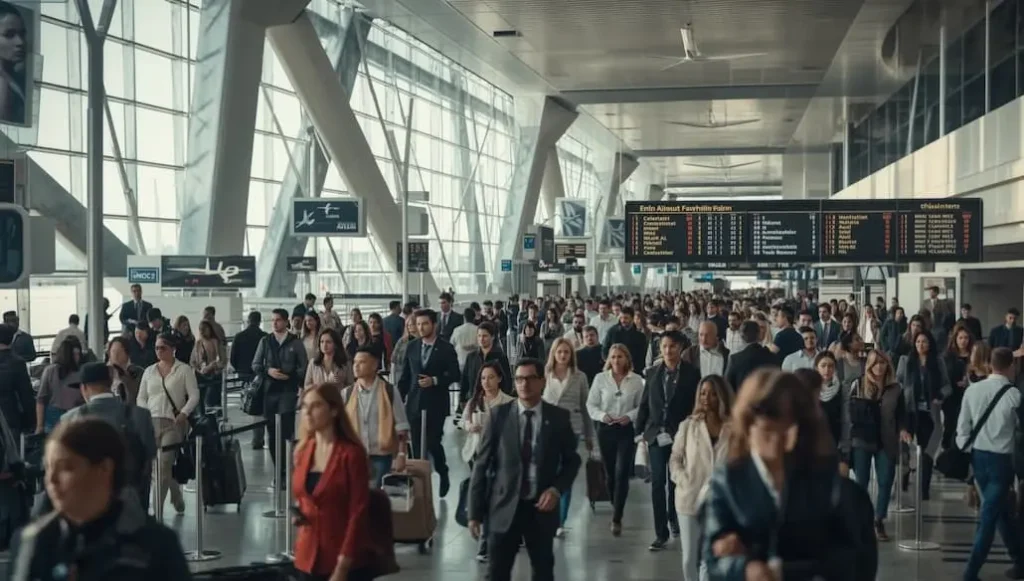
Zurich Airport is one of Switzerland’s most important transport hubs and a major gateway in Europe — with connections to numerous international destinations.
Use our free departure time calculator above: Simply enter your address, select the airport and departure time — and you’ll instantly receive your personal recommendation including check-in buffer and gate arrival, based on real Google Maps traffic data.
In this article you’ll also find a comprehensive guide to all questions around arrival times at Zurich Airport — with practical tips for a stress-free journey.
When do I need
to leave?
Enter your address — we calculate your ideal departure time with real drive time & check-in buffer.
Pre-trip planning
Travel preparation and document check
A successful trip begins long before the actual departure—namely with careful travel planning. Before heading to the airport, you should check all important documents: Is your passport still valid? Do you need a visa for your destination or for a layover? Review the current entry requirements for the country you are traveling to and also inform yourself about any possible changes in transit countries.
It is advisable to make copies of all important documents—such as your passport, visa, flight ticket, and ID—and store them separately from the originals. This way, you are on the safe side in case of loss or theft. Digital copies on your phone or in a secure cloud can also be extremely valuable in an emergency.
Don’t forget to inform yourself about the security situation and health recommendations for your destination. Many travel agencies and official websites provide up-to-date information on vaccinations, entry regulations, and local rules. With good travel planning and complete documentation, nothing stands in the way of a relaxed start to your vacation.
Transportation to the airport – options and time buffer
Getting to the airport is a crucial part of your journey—and one that is often underestimated. Think early about the best way to reach the airport: whether by car, public transport (train, bus, tram), taxi, or a professional airport transfer—each option has its advantages and disadvantages. Especially in cities like Zurich, traffic can be very heavy at certain times. Therefore, always plan a generous time buffer so you can arrive at check-in and security screening without stress.
If you are traveling by car, find out about parking options at the airport in advance and, if necessary, book a parking space online. Those traveling by train or bus should keep an eye on connections and possible construction work or service disruptions. Many airports provide up-to-date information on arrivals and departures as well as alternative routes on their websites.
As a rule of thumb: be at the airport at least two hours before departure—ideally even earlier for international flights or during peak travel times. This gives you enough time for check-in, baggage drop-off, and security screening, allowing you to start your journey in a relaxed way.
Important to-dos the evening before
The evening before departure is the perfect time to take care of the final preparations for your trip. Go through your checklist once more: Are all important documents such as your passport, visa, boarding pass, and flight ticket within easy reach? Have you packed enough cash, your credit card, and important contact details? Fully charge your phone, tablet, and other electronic devices, and pack a charger in your carry-on luggage.
Inform your bank and credit card providers about your trip so that your cards are not blocked abroad. Check once again that you have all necessary travel documents and ID with you—and, to be safe, make additional copies of them.
Ideally, lay out your clothes and pack your luggage the evening before. This way, you can start the next morning without stress and focus entirely on your journey. With good preparation the night before, you’ll be well equipped for a smooth process at the airport and a relaxed start to your vacation.
Why timing at the airport is so important
The importance of arriving at the airport on time is often underestimated—until it’s too late. Modern air travel is complex, highly regulated, and dependent on many factors beyond your control. Arriving late can be stressful or even costly—in the worst case, you may miss your flight.
First, there are security checks, which can take anywhere from 10 to 45 minutes depending on the time of day and passenger volume. Especially during holiday seasons or early in the morning, long queues are common. If you don’t arrive early enough, you may still be stuck at security while your plane is already taking off.
Then there is the boarding process, which usually begins about 30 minutes before departure. The gates typically close around 15 minutes before takeoff—after that, there is no turning back. Even if you have already checked in, you will not be allowed on board once the gate is closed.
Unpredictable events such as traffic jams on the way to the airport, technical issues at check-in, or missing travel documents should not be overlooked. By allowing a buffer of at least 2–3 hours (depending on the type of flight), you can avoid many of these worries.
At Zurich Airport, which handles around 30 million passengers each year, efficient planning is essential. After all, you want to travel relaxed—not sprint through the terminal with your heart racing.
Differences between domestic and international flights
Not every flight is the same. Domestic flights, flights within Europe, and long-haul flights have different requirements—especially when it comes to check-in, security screening, and travel documents. Depending on the region you are traveling to, these requirements may vary even further.
Domestic flights
In Switzerland, there are very few purely domestic flights, as train travel is often faster. The importance of the different cantons—such as Valais, Graubünden, Ticino, or Bern—also plays a role, as they offer varying geographical and climatic conditions for domestic flights. If you do happen to fly, for example from Zurich to Geneva, it is usually sufficient to arrive at the airport 60–90 minutes before departure. Since no passport or customs controls are required and baggage volumes are lower, the overall process tends to be quicker.
European flights (Schengen Area)
Flights within the Schengen Area—such as to Germany, Austria, or Italy—do not require a passport, but a valid national ID card is necessary. For German citizens, specific entry regulations apply that allow visa-free travel. Nevertheless, experts recommend arriving at the airport at least two hours in advance. Security checks can take a long time depending on passenger volume, especially in the morning.
International flights (non-Schengen)
For flights to countries such as the United States, the United Kingdom, or destinations in Asia, strict regulations apply. You must go through passport control, possibly a health or customs check, and there may be additional questions during boarding. For certain international connections, a transit visa is also required—even if you do not leave the airport. In these cases, you should arrive at the airport at least three hours before departure—3.5 hours for flights to the United States.
Important: The return journey from abroad can also be time-consuming on long-haul flights, so be sure to allow enough time for your return to Zurich. Make sure that visas and other entry documents are issued well in advance, as they are mandatory for entry into many countries.
Recommended arrival times for flights departing from Zurich
Now it gets specific: how much earlier should you arrive at Zurich Airport, depending on the type of flight?
When it comes to connecting flights, it is especially important to observe the recommended minimum connection time to ensure a stress-free transfer between flights.
Domestic flights – 60 to 90 minutes before departure
Only carry-on luggage? Sixty minutes is often sufficient.
With checked baggage? Plan for 90 minutes. In Switzerland, you can often check in your luggage at the train station, which makes the airport check-in process easier.
Fewer people, less stress—but don’t arrive too late.
Schengen flights – at least 2 hours before departure
Arriving early pays off: avoid stress at security checks.
Keep your travel documents (ID card or passport) ready.
Use self check-in or a mobile boarding pass. Remember to have your boarding passes—ideally both digital and printed—readily available at check-in and security screening to ensure a smooth process.
International flights – at least 3 hours before departure
You need a passport, and sometimes a visa—depending on the requirements of different countries.
Long waiting times at passport control are possible.
Baggage drop-off can take longer.
Special checks, e.g. for flights to the USA: allow extra time.
Zurich Airport is efficient, but very busy—especially during peak times. Better a little too early than too late!
The role of airlines in time planning
Not every airline operates the same way—and this has a direct impact on your schedule at the airport. While some airlines offer well-designed processes, digital services, and short waiting times, others can be quite hectic. It’s always worth checking your airline’s specific recommendations.
Good planning is especially important when transferring between flights, in order to catch connecting flights without stress.
Differences between low-cost airlines and premium airlines
With low-cost airlines such as EasyJet, Ryanair, or Wizz Air, you often need to be at the airport earlier. Why? Quite simply: these airlines usually have fewer staff at the counters, and the check-in desk often closes 45 to 60 minutes before departure. In addition, online check-in is mandatory with low-cost carriers—if you forget to do it, you often have to pay an extra fee at the airport. For additional services such as baggage or seat selection, there are various payment options, for example by credit card or directly at a self-service machine.
Premium airlines such as Swiss, Lufthansa, or Emirates are generally better organized. They offer additional services such as:
Evening-before check-in
Multiple check-in counters
Dedicated counters for Business Class or frequent flyers
Lounge access with priority check-in
Even with premium airlines, you should arrive 2 to 3 hours before departure, but the process is often much smoother.
What airlines recommend
Most airlines provide clear recommendations for arrival times on your ticket, in their app, or on their website. Here is an overview of common guidelines:
| Airline | Domestic flight | European flight (Schengen) | Intercontinental |
|---|---|---|---|
| Swiss | 90 min | 120 min | 180 min |
| Lufthansa | 90 min | 120 min | 180 min |
| EasyJet | 120 min | 120 min | – |
| Emirates | – | – | 180–240 min |
| Qatar Airways | – | – | 180 min |
Tip: Check your airline’s website or app the evening before to receive the latest updates—for example, regarding special security measures or delays. Mobile data or Wi-Fi is required for online check-in and for using the airline app.
Check-in and baggage drop-off – how long does it really take
This is often where it’s decided whether you’ll feel rushed or continue calmly: the check-in process can be very fast or quite slow—depending on many factors. In Switzerland, it is also possible at many train stations to check in your luggage before the journey. Especially at Zurich Airport, there are modern options available to reduce waiting times.
Online check-in vs. check-in at the counter
The easiest way to save time: check in online. With almost all airlines, you can conveniently check in 24 to 48 hours before departure using your phone or laptop. For travelers, online check-in offers the advantage of avoiding waiting times at the airport and responding more flexibly to individual needs. You receive your boarding pass digitally and can go straight to security—provided you have no checked baggage.
Checking in at the airport counter can be time-consuming—especially for international flights. Here, you should expect waiting times depending on the airline and time of day. Plan at least 30 to 45 minutes for the traditional check-in—on top of the recommended arrival time.
Baggage drop-off – when, how, and where
Even when checking in luggage, the rule applies: the earlier, the better. Baggage drop-off usually opens 2.5 to 3 hours before departure and closes 40 to 60 minutes before departure—depending on the airline. Zurich Airport offers self bag drop machines at many terminals, allowing you to check in your luggage yourself—provided you have already checked in online. Travelers should actively look for self bag drop machines to avoid waiting times.
Advantages of self bag drop machines:
Faster than staffed counters
No staff required
Usually shorter waiting times
You can find these machines, among other places, in Check-in 1 and Check-in 3 at Zurich Airport.
Tips for fast check-in at Zurich Airport
Use online check-in and self bag drop whenever possible.
Arrive outside peak hours (for example, not between 6–9 a.m.).
Find out in advance which terminal and check-in counters your airline uses.
Have your travel documents, booking confirmation, and luggage ready.
Those who plan efficiently here save valuable minutes—and start their flight far more relaxed.
Especially when traveling with connections, it is important to consider transfer times in advance in order to ensure a smooth process and allow enough buffer for possible delays.
Security screening at Zurich Airport
One of the biggest time-consuming steps at the airport is the security screening. It is mandatory for all passengers and can become a real test of patience, especially during peak periods.
Average waiting times
The waiting time at the security checkpoint depends on many factors: day of the week, time of day, destination, and overall passenger volume. At Zurich Airport, the average waiting time is:
Morning (6–9 a.m.): 20–45 minutes
Midday (11 a.m.–2 p.m.): 10–25 minutes
Evening (6–9 p.m.): 15–30 minutes
Tip: Current waiting times are displayed in real time on the Zurich Airport app or website—ideal for planning!
What is allowed in carry-on luggage
A common cause of delays: incorrect or incomplete carry-on luggage. Avoid stress by following these rules:
Liquids only up to 100 ml per container, maximum 1 liter total, stored in a transparent plastic bag
No sharp objects (nail scissors, knives)
Laptops, tablets, and large electronic devices must be removed from your backpack
Belts, jackets, and large metal objects should be removed beforehand
Anything that slows down the screening process affects you as well—so it’s best to be well prepared.
Priority lanes – are they worth it
For frequent flyers, business-class passengers, or travelers willing to pay an extra fee, Zurich Airport offers so-called fast lanes or priority lanes. These separate security lanes significantly reduce waiting times—especially during peak hours.
Cost: depending on the airline or available as a separate booking (e.g., from CHF 10). For those in a hurry or who simply value comfort, this investment is definitely worth considering.
Customs and passport control for international flights
If you are traveling to a non-Schengen country, you cannot avoid passport control at Zurich Airport—and depending on your destination, customs control as well. The requirements for entering a country vary by country and may include specific conditions such as visas or supporting documents. For many travelers, this is the step where time suddenly becomes tight. That’s why it’s important to know exactly what to expect and how to prepare.
Schengen vs. non-Schengen procedures
Zurich is a central airport for European and international travel, which is why the terminal is divided into two areas: Schengen and non-Schengen. Depending on where you are flying, you will either travel within the Schengen Area or to a country that requires additional checks. Procedures and security measures may also vary by region, as regional specifics and requirements are taken into account.
Schengen flights (e.g. Germany, France, Italy): No passport control for Swiss citizens or EU citizens.
Non-Schengen flights (e.g. USA, UK, Turkey): You must pass through passport control by border police. Waiting times of 20–40 minutes are possible—especially for long-haul flights in the evening.
Travel documents at a glance
The biggest delays often occur when passengers do not have the correct documents with them. To make sure this doesn’t happen to you, keep the following basic rules in mind:
| Destination | Required documents | Notes |
|---|---|---|
| EU/Schengen | National ID card or passport | Document must be valid |
| United Kingdom | Passport (ID card no longer accepted) | Visa required depending on nationality |
| USA | Passport + ESTA authorization | ESTA must be applied for online |
| Asia/Africa | Passport + visa if required | Check visa requirements of destination country |
Tip: Always check the current entry requirements for your destination at least one week before departure—they can change quickly. Required documents and regulations vary depending on the country you are traveling to and should be carefully reviewed in advance.
Traveling under special circumstances
Not every traveler is the same—some travel with children, others with physical impairments, or even with pets. These circumstances require special preparation and additional time. Zurich Airport offers dedicated services for such cases—you just need to be aware of them.
In an emergency, having quick access to a 24/7 emergency contact number is especially important in order to receive immediate assistance.
Traveling with children
Traveling with young children can be stressful—but with the right preparation, the process becomes much more relaxed.
Tips for parents:
Arrive early (at least 2.5–3 hours in advance)
Strollers can often be used up to the gate
Baby food and bottles are allowed in carry-on luggage despite liquid restrictions—please present them separately
Use family check-in counters and family lanes at security screening
There are play areas in the transit zone (especially near Gate A)
Well-prepared trips with children ensure that positive experiences take center stage for the whole family.
Traveling with reduced mobility
For passengers with walking difficulties or other physical impairments, Zurich Airport offers a barrier-free service.
Important notes:
Report your mobility limitation at least 48 hours before departure to the airline or through your travel agency
Assistance services, wheelchairs, and dedicated check-in counters are available
Access to lounges, restrooms, and gates is barrier-free
Security checks provide special access for passengers using mobility aids
Traveling with pets
Traveling with pets is also possible—but there are clear rules.
Inform the airline in advance about your pet (whether traveling in the cargo hold or in the cabin).
Check-in may take longer—arrive at least 3 hours before departure.
Carrying a valid EU pet passport is mandatory.
Animals must be transported in an approved carrier.
Zurich Airport even offers animal care services and special transport options—highly recommended for long-haul flights.
What to do in case of a delay or missed flight
Despite careful planning, it can still happen: you arrive too late, miss your flight, or your connecting flight is delayed. In such cases, it is often necessary to switch to another flight. The key then is to stay calm and know what to do.
Passenger rights under EU regulations
Under the EU Air Passenger Rights Regulation (EC) No. 261/2004, you as a passenger have certain rights—even for flights departing from Zurich. Here is an overview:
Delay of more than 2 hours: Entitlement to care (drinks, snacks, communication)
Delay of more than 3 hours: Depending on the distance, entitlement to compensation (€250–€600)
Cancellation: Right to a replacement flight or a refund
Denied boarding (e.g. due to overbooking): Right to compensation and alternative transport
These rights apply only to EU airlines or if you are departing from an EU airport such as Zurich.
In addition, taking out travel insurance can provide extra protection in the event of delays.
What to do in case of long waiting times
If your flight is delayed or you have to wait for many hours:
Use lounges (e.g. Aspire Lounge in Terminal A)
Explore the shopping options (over 80 shops and restaurants)
Use free Wi-Fi for work or entertainment
If the waiting time exceeds 6 hours: arrange accommodation (there are various options, including hotels directly within the airport complex)
Tip: Download your airline’s app before traveling – there you’ll find all current updates, gate information, and alternative rebooking options at the touch of a button.
Tips for saving time at Zurich Airport
A well-planned day at the airport can run like Swiss clockwork—if you know the right tricks. Targeted searching for suitable services and offers at the airport can also save you time and help you make the most of your stay. Zurich Airport offers many ways to save time and organize your visit efficiently. With these tips, you’ll not only start on time, but also relaxed.
Use evening-before check-in
A real game changer for early departures is evening-before check-in. Many airlines—including Swiss, Lufthansa, and Edelweiss—offer this service directly at Zurich Airport.
Advantages:
Drop off your luggage the day before
Go straight to security control on the day of travel
A stress-free start, especially when traveling with children or lots of luggage
Times & conditions:
Usually available between 6:00 p.m. and 10:00 p.m.
Valid for flights departing the next day (often until 12:00 noon)
Travel documents and flight ticket required
Best of all, you can also check in other family members or travel companions—provided you have their IDs and tickets.
Fast-track services
Fast-track access lets you get through security checks more quickly—perfect for business travelers or anyone who wants to save valuable time.
How it works:
Either included in your flight ticket (e.g. Business Class)
Or bookable for an additional fee directly at the airport or online
Access to separate security screening lanes
Prices: from around CHF 10 (depending on the airline or provider)
Tip: Check whether your credit card (e.g. Gold or Platinum) includes priority services free of charge.
Pack your carry-on luggage smartly
Those who travel with carry-on luggage only not only save time at check-in, but also at the baggage carousel upon arrival. However, this only works if you pack smart—and follow the rules.
What belongs in your carry-on luggage
Important documents, medications, valuables
Electronic devices (laptop, camera, chargers)
Maximum of 1 liter of liquids (in 100 ml containers)
What to avoid
Large liquids such as shampoo or deodorant in original sizes
Sharp objects (nail scissors, pocket knives)
Excess weight – this can be expensive!
With a well-thought-out suitcase and good time management, you’ll travel much more relaxed—and can even enjoy your time at the airport.
The role of modern technologies in time planning
In a digitalized world, your airport visit should be smart as well. Many apps and websites offer photos for better orientation or for choosing services. Modern technologies help you plan better, navigate faster, and stay informed at all times. Zurich Airport is technically very well equipped—you just need to know how to use the tools correctly.
Mobile apps of the airlines
Most airlines now offer apps with many useful features:
Online check-in
Mobile boarding pass
Push notifications for gate changes or delays
Booking of additional services (seats, baggage)
Top airlines with good apps:
Swiss
Lufthansa
Emirates
EasyJet
Qatar Airways
Tip: Enable push notifications to stay informed in real time.
Zurich Airport app
This app is a real must-have if you are departing from or arriving at ZRH. Overview of its features:
Live flight information
Current waiting times at security checkpoints
Terminal maps for easy orientation
Shopping and dining guide
Real-time parking availability
The app is available for free in the App Store and on Google Play.
Automated check-in and baggage drop stations
Modern technology is now replacing staff in many areas—to your advantage. Zurich Airport offers:
Self check-in kiosks (available with almost all airlines)
Self bag drop for checked luggage (usable only with online check-in)
Automated passport controls for Schengen travel (for EU citizens with biometric passports)
With these tools, you can complete many steps at Zurich Airport in just a few minutes—saving valuable time and reducing stress.
Arriving early at the airport – what to do with the time
If you’ve done everything right and made it through security early—now what? No worries: Zurich Airport is not only a major transportation hub, but also a true experience center. From various areas of the airport, you can enjoy impressive views of Swiss nature and soak up a bit of nature even before departure. Whether shopping, relaxing, or entertainment—there’s no chance of getting bored here.
Lounges, shops, and restaurants at Zurich Airport
If you have a bit more time (and the budget allows), airport lounges are the perfect place to relax.
Top lounges at ZRH:
Swiss Business Lounge (Dock A & E)
Aspire Lounge (Dock E)
Primeclass Lounge (Check-in 1, publicly accessible)
Lounges offer:
Snacks, hot meals, and drinks
Comfortable seating areas
Workspaces with power outlets to charge your electronic devices
Showers and quiet rest areas
Shopping enthusiasts will also find plenty to enjoy: more than 80 shops offer everything from luxury goods to souvenirs, including:
Victorinox
Lindt
Bally
Zurich Wine Shop
When it comes to food, you’ll find everything from fast food to fine dining:
Sprüngli (a Swiss classic)
Marché (fresh and regional)
McDonald’s or Pret A Manger (quick and affordable)
Free Wi-Fi & work areas
Whether you want to work or simply relax, the free Wi-Fi throughout Zurich Airport has you covered.
First 2 hours free, then subject to a fee
Many seating areas with USB ports and power outlets
In lounges: high-speed Wi-Fi with no time limit
Family areas & play zones
For parents traveling with children, there are dedicated areas with play zones, changing rooms, and even family rooms for breastfeeding or resting.
Locations:
Play area near Gate A
Baby changing facilities at almost all restrooms
Family-friendly restaurants with high chairs
Whether you’re traveling for business, with family, or solo—the Zurich Airport aims to make your stay as comfortable as possible.
Conclusion – How early should you be at Zurich Airport
In summary, arriving early at Zurich Airport is not just a recommendation—it’s the key to a stress-free journey. From Zurich Airport, you can reach a wide range of exciting destinations worldwide, which further highlights the importance of good planning. Even though Zurich is known as an efficient and well-organized airport, you should always take different procedures, flight types, and individual circumstances into account.
Recommended arrival times at a glance:
Domestic flights: 60–90 minutes
Schengen flights: 2 hours
International flights: 3–3.5 hours
Traveling with children, pets, or special assistance needs: +30–60 minutes
With the right preparation, smart luggage management, and the use of modern technologies, you can not only save time but also start your journey relaxed. And remember: better to be 30 minutes too early than 3 seconds too late.
Frequently Asked Questions (FAQs)
1. Is it enough to be at Zurich Airport 1 hour before departure?
Only for domestic flights or if you have no checked baggage and have already checked in online. For all other cases, 1 hour is very tight.
2. What happens if I miss my flight?
Contact the airline immediately. Depending on your fare, you may be entitled to rebooking—often for a fee. EU passenger rights may apply.
3. Are there differences between terminals in Zurich?
Yes. Zurich has Check-in 1, 2, and 3—depending on the airline and destination. Check the information on your ticket or in the app.
4. How early does the check-in counter open?
Usually 2.5–3 hours before departure. Often even earlier for long-haul flights. Evening-before check-in is available with many airlines.
5. When is Zurich Airport the quietest?
Between 10:30 a.m. and 1:00 p.m., as well as after 9:00 p.m. Tuesdays and Wednesdays are also considered less busy.